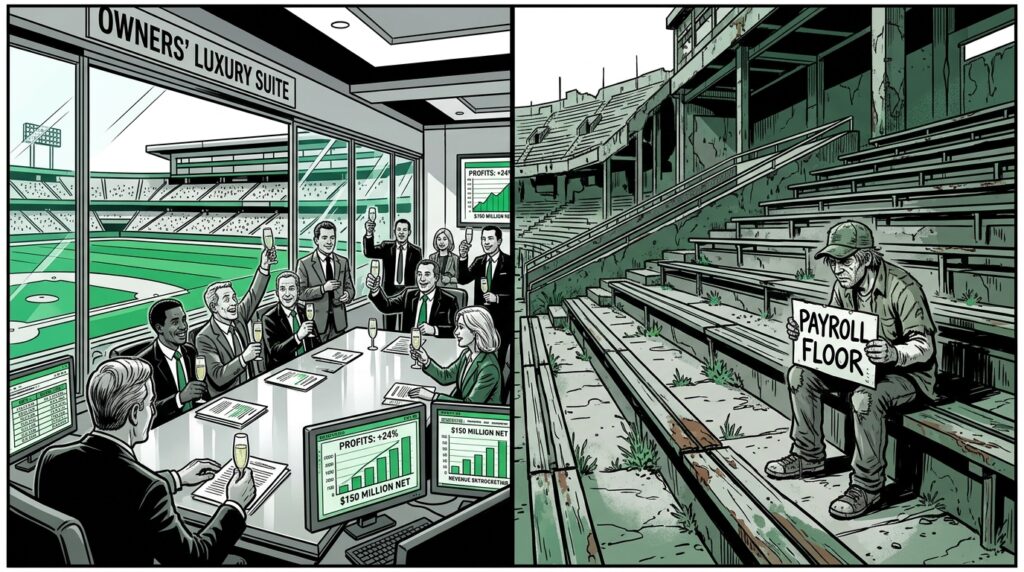
The owners want a $245.3 million hard cap. They want it paired with a $171.2 million hard floor. They’re calling it competitive balance. Anyone who watched what happened to baseball in 1994 should be skeptical — and anyone who roots for a team like the White Sox should read the fine print before getting excited about that floor number.
Here’s the situation: MLB owners put forward their opening proposal in late May 2026 CBA negotiations, a 7-year structure running 2027 through 2033. The MLBPA — now led by interim executive director Bruce Meyer after Tony Clark’s resignation in February — rejected any cap framework outright. Bryan Reynolds called it a “nonstarter.” Chris Bassitt said the two sides are “very, very far from it.” Tarik Skubal said it’s “not good for players.” That’s a pretty unified front from a union that has occasionally shown cracks in recent years.
MLB salary cap 2026 coverage has focused heavily on the $245.3M ceiling, but the floor is where small-market fans are supposed to find comfort. Twelve teams currently sit below the proposed $171.2M floor, and the owners’ math shows those clubs would need to increase their combined payroll by $617 million to comply. The White Sox, sitting around $110M in current commitments, are one of those teams — roughly $61 million short of the threshold. That sounds like a mandate for investment. It isn’t, necessarily. It’s a mandate to spend. On what, exactly, and at what quality, is left entirely to ownership discretion.
The ceiling is the thing. A $245.3M hard cap represents a significant reduction in what clubs like the Dodgers and Mets currently commit in luxury-tax exposure. Jeff Passan has reported that stagnating franchise values — not competitive balance — are driving the owners’ urgency here. The cap isn’t designed to make the White Sox more competitive. It’s designed to stop the Dodgers from spending $375M, which keeps franchise valuations from diverging so dramatically that the bottom third of ownership looks like they’re running a different business. The floor is real. But the floor is also a PR fig leaf stitched to a cost-containment bill.
This is where 1994 becomes relevant, not as nostalgia but as instruction. The 1994 MLB strike began on August 12th of that year, canceled 921 regular season games, wiped out the World Series entirely, and lasted until the owners withdrew their cap demand in early February 1995 after the NLRB ruled it had been illegally imposed — though the strike itself did not end until April 2, 1995, when a federal court injunction forced a return to play, with no actual CBA settlement until December 1996. Attendance fell 20% the season after play resumed. Fans in smaller markets, who had been told a cap would help their teams compete, got nothing. Owners lost that fight. They never forgot it.
The 1994 owners’ proposal also included a 50/50 revenue split — structurally similar to what’s being discussed now. The players’ position was then, as it is now, that any artificial ceiling suppresses wages without a guaranteed corresponding improvement in competitive outcomes. The floor forces spending but can’t force intelligent spending. A team can spend $171M on bad contracts and still lose 100 games. The White Sox, if we’re being honest with ourselves, have done something adjacent to that without a floor mandate.
What’s different in 2026 is that the union is weaker in some ways and more sophisticated in others. The MLBPA lost significant ground in the 2022 CBA — service time manipulation, pre-arb pay structures, expanded playoffs that dilute the value of the regular season. Bruce Meyer doesn’t have the institutional credibility Tony Clark had built (whatever you thought of Clark’s tenure), and the players know the 2027 deadline is real. Ken Rosenthal has noted that a cap structure risks games in 2027 if negotiations stall — which means the owners have a clock to leverage.
MLB spokesman Glen Caplin is out there making the case for the cap proposal. The owners are making noise about parity. Meanwhile, the White Sox are sitting at $110M in payroll after years of a rebuild that hasn’t fully delivered, and the suggestion that a hard floor would fix that ignores the decade of organizational decisions that got this franchise here. A floor mandate doesn’t change incentive structures. It changes minimum spend requirements. Those are not the same thing.
The players are right to reject any cap outright. The small-market fan instinct to root for the floor is understandable, but the structure being proposed gives owners the cost certainty they’ve always wanted while offering fans a dressed-up promise of competitive balance that cap sports have struggled to consistently deliver. The NFL has a cap. It also has the Jacksonville Jaguars. The NHL has a cap. It also has the Columbus Blue Jackets. Spending floors don’t manufacture relevance.
Thirty-two years ago, owners went to the mat on this and lost. Whether they’ve built enough leverage to win it this time is the only question that matters. The players’ answer, so far, has been a hard no.
The MLBPA made its first proposal to MLB today in collective bargaining. Among the topline issues:
– A "competitive-integrity tax" for any team that does not spend $150M
– Increase minimum salary from $780,000 to $1.5M
– Increase in base CBT threshold from $244M to $300M— Jeff Passan (@JeffPassan) May 27, 2026